


Detail from Lambeth Palace Library MS 6 folio 43v illustrating the brawling dragons episode in Geoffrey of Monmouth's Historia Regum Britanniae. Unknown illustrator, c. 15th century CE.
The story of dragons in Britain begins with the tale of Lludd and Llevelys, vividly narrated in The Mabinogion, a twelfth-century Welsh collection of much older legends.1 Lludd’s kingdom suffered three plagues – the arrival of spies from the Coraniaid, who could somehow hear every word spoken in the royal court; the mysterious disappearance of all the court’s food supplies each night; and a terrible shriek that blighted the island every May Day, draining men’s strength, causing women to miscarry, and killing crops and animals. Lludd conferred with his Sherlock Holmes-like brother, Llevelys, king of France, and the cause of the plagues was revealed.
The Coraniaid were defeated by the application of a magic concoction brewed from crushed beetles – obviously. The court food was disappearing into the stomach of a huge giant who magicked everyone to sleep before indulging in his thievery. Lludd thwarted the sleep spell by plunging himself into a vat of icy water to stay awake and confronted and defeated the giant.
The land-blighting May Day shriek, meanwhile, was caused by two dragons, engaged in an eternal battle like a huge, scaly, fire-breathing metaphor. One was the Red Dragon of Britain; the other was a White Dragon, representing the Anglo-Saxons who hadn’t yet appeared in the story. Clever Llevelys told Lludd how to conquer the reptiles, instructing him to first locate the geographical centre of Britain, which Lludd’s dodgy mathematical equipment revealed as Oxford. Lludd’s navvies then dug a deep pit in the centre of the town, in which a mead-filled cauldron was placed. The pit was covered with a satin cloth to conceal the Scooby-doo-like trap.
At dusk, the two airborne dragons appeared, eventually plunging into the pit from exhaustion. Transforming themselves into pigs, they drank the mead and fell into a drunken slumber. Lludd’s team wrapped the dragon-piggies in the satin cloth and hauled them to Snowdonia, burying them deep at the foot of the fortress Dinas Ffaraon on Mount Snowdon. Hurrah, no more May Day plague.
Enter Merlin…
The dragons slept off their indulgencies until the fifth century AD, when King Vortigern, harried by Anglo-Saxon usurpers, attempted to rebuild the fortress on Snowdon, calling it Dinas Emrys. However, after each attempt to build, the masonry collapsed. Vortigern’s court Druids advised him that only the blood of a fatherless child could stabilise the walls. Such a one was found – Merlin, whose mother was mortal but whose father was a demon. However, the intended sacrificial victim exposed the Druids’ ignorance and told Vortigern to dig. Under the fortress’s foundations, the workmen found a pool, at the bottom of which sat two stone troughs containing the dragons buried by King Lludd. Released to recommence their battle, the Red and White dragons took to the air and locked claws.
The White initially had the upper hand, but eventually the Red rallied its strength, let out a terrible cry (presumably the one that blighted the crops, etc.) and forced its foe to submit. Merlin interpreted this scrap as a prophecy about Britain’s future. The White Dragon was the invading Anglo-Saxons, while the Red one was the native Britons. Although the Saxons would oppress the island for generations, the native Cymry would eventually rise, unite, and reclaim their ancestral lands and freedom. This legend permanently linked the Red Dragon to Welsh identity, establishing the creature as a primary emblem of resistance, royal (non-English) authority, and national survival.
The legend of Vortigern’s dragons was created by Nennius in the 9th century AD. In his version, Merlin is called Ambrosius. Geoffrey of Monmouth picked up the plot and gave it a political punch, taking Nennius’ optimistic vision of an ascendant Red Dragon as a reality. Oxford-based Geoffrey was writing for a Norman aristocracy with strong Breton links, and the Bretons were the original Britons displaced by the invading Anglo-Saxons. For Geoff, the legend of the Red and White is the story of the Saxons getting their comeuppance in 1066.
Inspired by Merlin’s prophetic visions and the fiery celestial omens that appeared in the night sky, King Arthur’s father, Uther (three kings on from Vortigern, sometime around the latter half of the fifth century AD) used two golden dragons as his military standards. This act earned him the title Pendragon, meaning Head Dragon (i.e., top dog of the British warlords). Uther adopted the golden dragon as his royal insignia, ensuring that whenever British warriors marched into battle against foreign invaders, they did so beneath the protective gaze of the dragon emblem, a symbol inherited by Uther’s son, King Arthur.
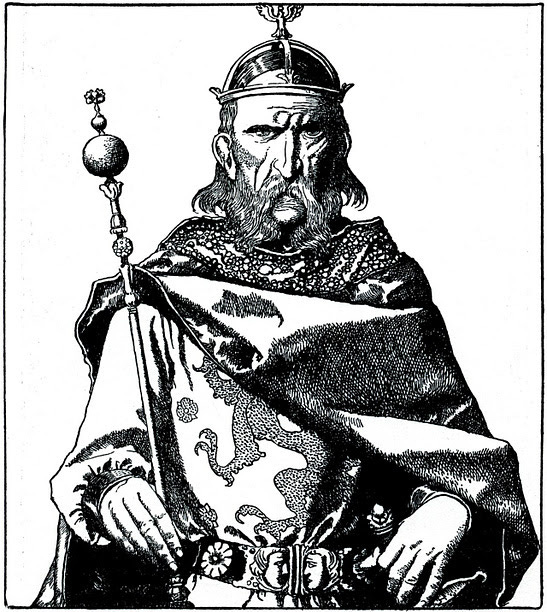
Uther Pendragon, with dragon shirt, by Howard Pyle from The Story of King Arthur and His Knights (1903)
This dragon insignia appears as a symbol across the various tellings of the Arthur legends. In Geoffrey of Monmouth’s Historia Regum Britanniae and Wace’s Roman de Brut, Arthur carries a golden dragon standard and wears a matching dragon helm. In later medieval romances, the dragon banner has magical properties, breathing fire and smoke to unnerve enemies.
But how had the Red Dragon become the Golden Dragon?
The Origin of British Dragons
The colour-shift from the red dragon of the Lludd and Vortigern legends to the golden dragon of Uther and Arthur seems like a fumbled plot device; however, to Geoffrey’s twelfth-century Anglo-Norman patrons, the Red Dragon was associated with contemporary Welsh rebellions and anti-Norman prophecies of British vengeance, almost as if the evil Saxon White Dragon had switched allegiance to the Normans. By changing the dragon’s colour to gold, Geoffrey avoided suggesting that Arthur was a Welsh warlord, setting him up as a pan-British European emperor. He was also probably linking Arthur’s insignia to folk memory of the golden draco standards of the late Roman Empire in Britain, which featured a hollow bronze dragon head attached to a long, fabric windsock body. When soldiers charged at a full gallop, the wind rushing through the metal jaws created a howling sound, and some versions even spat sparks and smoke. This would appear to be the origin of Arthur’s fiery banners, the legends of real, fire-breathing monsters, and Lludd’s ruinous dragons. (Geoffrey’s choice of gold for his Arthurian dragon banners also echoes the golden heraldry favoured by the ruling Norman kings, who were rather Trumpian in matters of taste.)
The dragon legends in the Matter of Britain stories may have been bolstered by finds of fossilised reptile bones in quarries and along the island’s coastline – who knows. Stories of dragons also reflect deep-seated cultural anxieties about untamed wilderness, such as marshes and forests, poisoned water supplies, and barren land.
Introduction to Dragon-spotting
There are four broad categories of dragon in Britain: the Fire-Drake, the Worm, the Wyvern, and the Sea Serpent. The first in the list is the rarest: the fiery Scandinavian-style beastie as encountered, fatally, by Beowulf. This is the species that Tolkien ran with in The Hobbit and other stories. Comets were sometimes interpreted as fire-dragons of this kind, including the ones spotted in the skies over Lindisfarne prior to the invasion of the Vikings in AD 793. The dragon slain by late-second-century AD St George at Uffington Castle in Oxfordshire is usually depicted as a classic Scandi four-legged-with-wings-and-fire monster, too; but sometimes not.
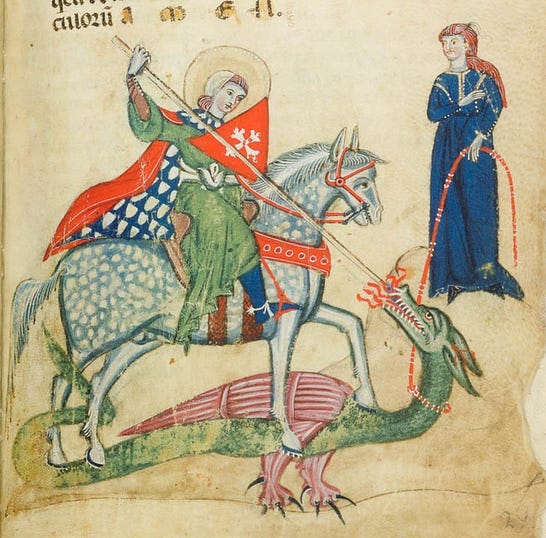
St George and the Wyvern - miniature from a 13th-century Passio Sancti Georgii (Verona)
The commonest species in the dragon family is the snakelike Worm or Wyrm, the favoured beast in legends from northern England. The third type is the Wyvern, known in Wales as the Gwiber (both words related to “viper”, from the Latin vipera), a relatively small, snakelike creature with two legs, wings, and a long tail.2 The sea serpent is an aquatic relative of the Worm.
As a lengthy postscript to this story of symbolic and politicised dragoneering, I’ve included some of my favourite British dragon legends, along with their origins, in a forthcoming paid-subscriber post. Meanwhile, I’ll end on a dignified and sombre note with this quote from that most venerable and serious of folk ballads, The Lambton Worm, which is the subject of the third post in this dragon trilogy, coming your way next Thursday:
Whisht! lads, haad yor gobs, aa’ll tell ye aall an aaful story,
Whisht! lads, haad yor gobs, an aa’ll tell ye aboot the worm.
Sources
Various, Folklore, Myths and Legends of Britain (1973)
Katherine Briggs, A Dictionary of Fairies (1976)
Geoffrey of Monmouth, Historia regum Britanniae (1136) https://www.gutenberg.org/ebooks/16491
David Day, The Quest for King Arthur (1995)
https://sites.pitt.edu/~dash/britishdragons.html#linton
The pellet with the poison’s in the flagon with the dragon; the vessel with the pestle has the brew that is true…
Even better, if you’ve enjoyed this article, please consider taking out a full subscription to A Stranger In Your Country. Subs are 50% off at the moment. My wonderful paid subscribers make the huge amount of work that goes into this Substack worthwhile. Thanks for your support!
A paid subscription will get you a free copy of my history quiz book Odd One Out, original folk-rock music on CD or download, and exclusive articles and quizzes, in addition to the full Stranger archive. Thanks for your support!
1 Lludd is probably the same mythical character as Geoffrey of Monmouth’s King Lud (of Ludgate, London fame); in which case he was enjoying his mythical rule in the first century BC and was the father of Cassivellaunus, who faced down Julius Caesar in 54 BC.
Gwiber is also the common Welsh name for the adder or viper.
Great article Paul. I may be wrong about this but I don't think Historia Regum Britanniae is discussed as part of the British School curriculum. It seems to me (and I am not a historian but a biologist) that it is the foundation of much of our cultural heritage - Arthurian stories and Merlin, King Cole (Coel), Shakespeare's Lear and Cymberline, Brutus of Troy, Royal mythology. I am sure I had no mention of it at school, yes a flavour of Arthur at Primary School but nothing more. Such a pity imho.
I love this. The way you write about the folklore throughout is just so engaging. Brilliant piece.